


Cathedral, tulip or compass: ring prongs and baskets explained
Updated November 2026 · 7 min read
Quick answer
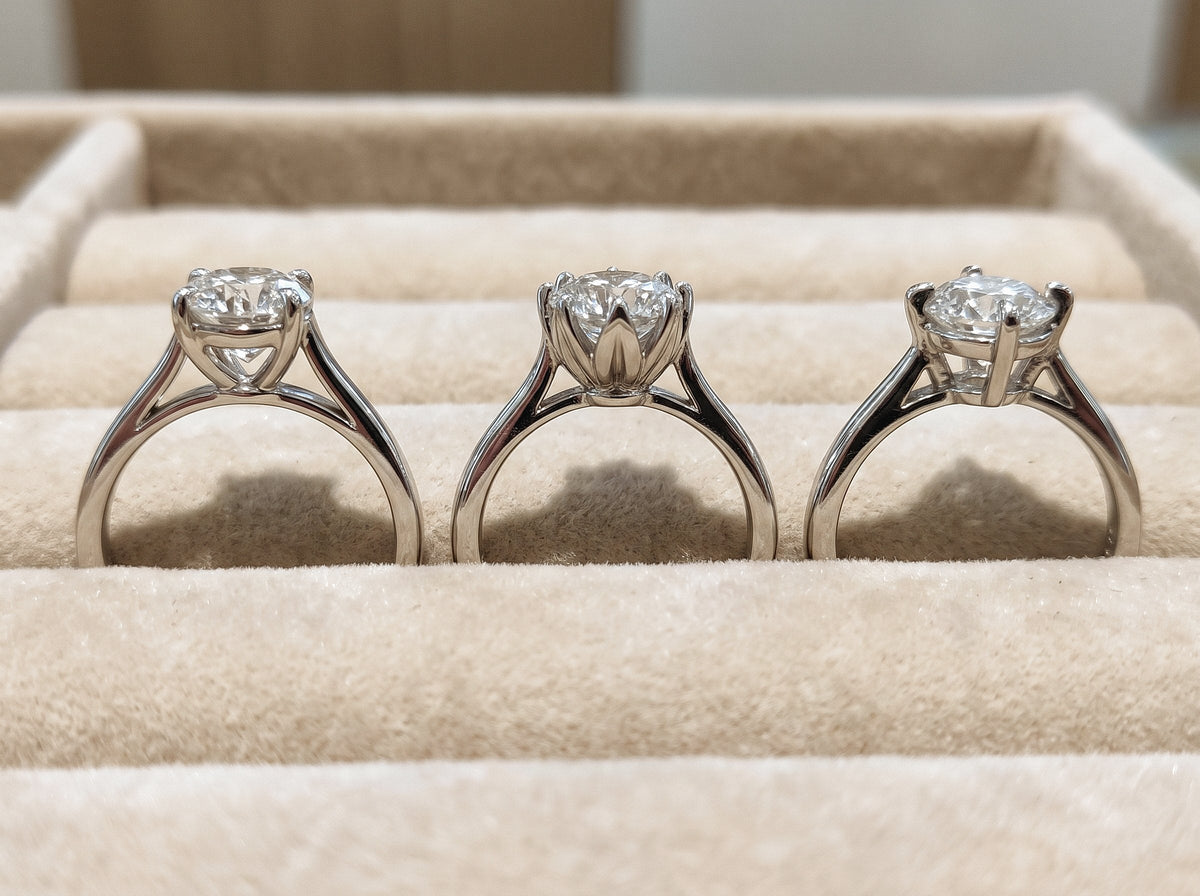
The head is the top of the ring that holds the diamond. Prongs are the metal tips that grip it. The basket is the frame under the stone that joins them. Six prongs hold the stone more securely than four. V prongs protect points. A cathedral lifts the head on metal arches. A tulip basket curves like petals. Compass prongs sit north, south, east and west.
What are the head, prongs and basket?
The head is the top part of the ring that holds the diamond. Prongs are narrow metal strips that rise from the base and bend over the edge of the stone.
The basket is a frame of small rails that joins the prongs under the diamond. GIA says it keeps the prongs steady and is often used for larger or deeper stones.
Four or six prongs?
- Four prongs use less metal and show more of the diamond. On a round stone they make the outline look a little square. Four prongs also suit princess and cushion cuts.
- Six prongs hold the stone more securely. GIA says that if one prong breaks in a six prong setting, the stone will most likely stay in place. Six prongs also make a round stone look rounder.
GIA says security matters most. But on stones under half a carat, six prongs can crowd the diamond. Our Violet holds a 3 carat oval in six prongs.
Claw, round, double or V prongs?
- Claw prongs: taper to fine points that outline the stone clearly.
- Round prongs: smooth, rounded tips with no points.
- Double prongs: two thinner prongs at each spot. GIA says they are often used at the corners of stones of 3 carats and up. If one prong fails, the other one still holds. Our Emmie holds a 5 carat oval in double claw prongs.
- V prongs: a V of metal that covers a point or corner. GIA says they are used on pear, marquise, princess and heart shapes, and they lower the risk of chipping. Our Rylee holds a marquise with two V prongs in white gold.
What are compass prongs and east west settings?
Compass prongs sit at north, south, east and west instead of at the corners. One designer told JCK that this makes the stone look like it floats on the band. On a long stone, two of the four prongs land on the tips. Our Milla holds a pear in compass prongs in a low set design. On sharp square corners, V prongs or a bezel protect better.
East west means the stone is set sideways, across the finger. Our Madison holds an emerald cut east west, with four prongs at north, south, east and west.
What is a cathedral setting?
In a cathedral setting, arches of metal rise from the band and hold up the head. GIA says this lifts the diamond higher above the band so it stands out more, and that the higher head can catch on clothes more easily.
Because the arches lift the head, many cathedral designs leave room for a wedding band to sit flush. Our Willa and Clara, both set east west, are made this way. Our setting height guide explains how a band fits.
What is a tulip basket, and what other baskets are there?
Tulip is a name ring makers use, not a lab term. From the side, the basket and prongs curve out and up like the petals of a tulip. Our Lauren holds an elongated cushion in a tulip design. Tamar has milgrain prongs on a sculpted tulip style basket.
- Lotus basket: our Mariah holds an oval in a lotus shaped basket, set low for everyday wear.
- Hidden halo: a ring of small diamonds tucked under the center stone. You see it sparkle from the side, but from the top you mostly do not see it. Our Chloe has a cathedral setting and a hidden halo.
Do white or platinum prongs make the diamond look whiter?
They can help it look whiter, but they do not change the grade of the stone. What they do is stop yellow metal from reflecting into it. GIA explains that the facets work like small mirrors, so yellow prongs can make a colorless diamond look more yellow. That is why designers often put white prongs on yellow or rose gold rings.
Our lab grown center stones are F color or higher, a colorless grade, so white prongs keep them looking as white as they are. GIA also says platinum prongs are less likely to break. Our Edith has platinum prongs on a 14K yellow gold band.
Prong and basket types at a glance
| Prong or basket type | What it looks like | Best for |
|---|---|---|
| Four prongs | Four tips, more diamond shows | Less metal; princess and cushion cuts |
| Six prongs | Six tips around the stone | Security; a rounder look on round stones |
| Claw prongs | Tips that taper to fine points | A clear outline around the stone |
| Round prongs | Smooth, rounded tips | Less snagging than claws |
| Double prongs | Two thin prongs at each spot | Large stones, about 3 carats and up |
| V prongs | A metal V over a point or corner | Pear, marquise, princess and heart shapes |
| Compass prongs | Four prongs at north, south, east and west | A floating look; tips of long shapes |
| Cathedral | Metal arches that lift the head | More height; room for a straight band |
| Basket | Rails that join the prongs under the stone | A steadier hold; larger or deeper stones |
| Tulip basket | Curves like petals from the side | More detail in the side view |
| Hidden halo | Small diamonds tucked under the stone | Extra sparkle from the side |
How often should you check your prongs?
GIA suggests having prongs checked every six months. Prongs wear down slowly, and a hard knock can bend one. Jewelers fix worn prongs by rebuilding the tips with new metal. If the stone moves or a prong looks bent, take the ring off and have it checked.
Our lifetime warranty covers prong tightening, cleaning, inspection and rhodium plating for free. It does not cover loss or theft of the center stone. That is one more reason to check often.
At Next Diamonds
We have many cathedral and hidden halo designs, and also compass or east west designs, double prongs and six prongs. Every ring is hand crafted to order in solid 14K or 18K gold or 950 platinum. Many designs also come in gold with platinum prongs. See all engagement rings or the Hidden Halo style collection. If you want a different prong on a design you like, send us a custom request by chat or email.
Questions people ask
Which prong style snags the least?
Round tips are smoother than pointed claws, and a low head catches less than a high one. A bezel snags the least of all. Our bezel guide compares them.
Are four prongs enough?
For many solitaires, yes, if you have them checked often. Six prongs give you extra safety.
Does a cathedral setting sit high?
Usually higher than a plain solitaire. Heights vary, so check the side photo of the ring. Our high set or low set guide shows how to read it.
Is a hidden halo the same as a gallery rail?
No. A gallery rail is a plain metal rail in the basket that joins the prongs. A hidden halo is a row of small diamonds that sits on that rail, under the center stone.
Can I get platinum prongs on a yellow gold ring?
On many of our designs, yes. For any other design, send us a custom request by chat or email.
Want a different prong?Many of our designs come in gold with platinum prongs. If you want a different prong on a ring you love, ask us in the chat.
Shop engagement ringsSources
- GIA, Complete Guide to Engagement Ring Settings: Types vs. Styles, August 2026
- GIA, How to Decide: Four Prongs versus Six Prongs for Your Engagement Ring
- GIA, How to Protect Your Diamond from Chipping
- GIA, How Metal Affects Diamond Color Appearance
- JCK, Jewelers Applaud Zendaya's Ring for Spotlighting the East West Setting, January 2025
More guides
-
Is a lab grown diamond real? What to say when people ask
A lab grown diamond is a diamond. How only a lab can tell, why mined diamonds seemed so rare, what happened to prices, and what to say.
-
Will a lab grown diamond pass a diamond tester?
Yes, it tests as diamond. Why some HPHT stones read moissanite, why a tester cannot tell lab grown from mined, and how to prove yours.
-

Bezel, half bezel or prongs: which setting is right for you?
Does a bezel make the diamond look smaller or sparkle less? Bezel, half bezel and prongs compared for security, snagging, sparkle and care.


