


Is a lab grown diamond real? What to say when people ask
Updated November 2026 · 7 min read
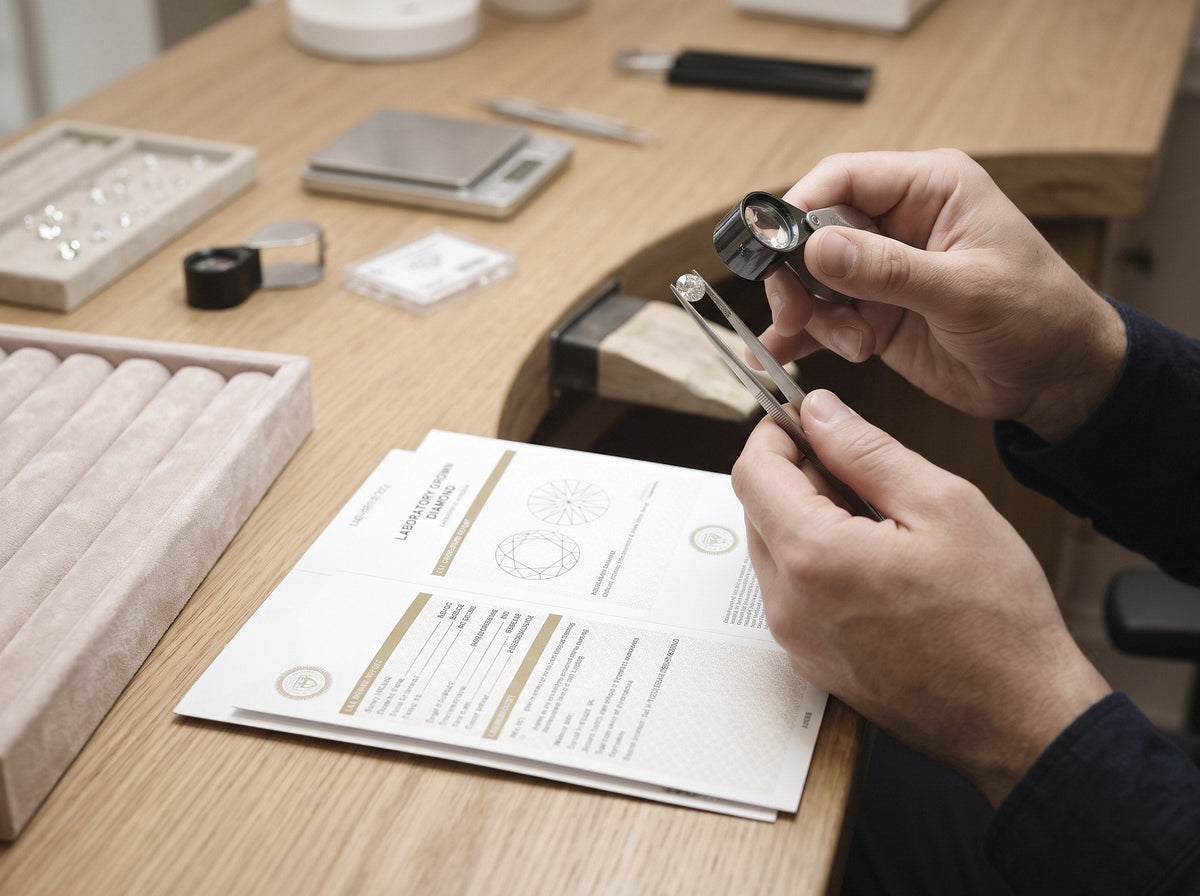
Quick answer
A lab grown diamond is a diamond, not an imitation. It has the same look, the same chemistry and the same crystal structure as a mined diamond, and it is just as hard. The only difference is where it grew: in a lab instead of deep in the earth. In 2018 the US Federal Trade Commission (FTC) dropped the word "natural" from its definition of a diamond. Only a gem lab with special equipment can tell them apart for sure, and the grading report says which one you have.
Is a lab grown diamond a diamond?
Yes. A lab grown diamond and a mined diamond share:
- The same look: the same sparkle, fire and brightness. You cannot tell them apart by eye.
- The same chemistry: essentially pure carbon.
- The same crystal structure: carbon atoms in a cubic crystal.
- The same hardness: 10 on the Mohs scale, the hardest of all.
- The same grading: IGI grades them with the same 4Cs: cut, color, clarity and carat.
The FTC Jewelry Guides say a diamond is essentially pure carbon in a cubic crystal. In 2018 the FTC dropped the word "natural." Its reason was that stones made in a lab with essentially the same optical, physical and chemical properties as mined diamonds are diamonds too. Only the origin is different.
The same FTC guides also tell sellers not to call anything made in a lab "real," "genuine" or "natural." That is why jewelers say "lab grown diamond." It is a diamond, and it was grown in a lab, not mined.
Can anyone tell it is lab grown?
Not by looking. GIA says standard gem tools cannot tell lab grown and natural diamonds apart.
- Basic diamond testers measure how a stone carries heat. A lab grown diamond reads "diamond," because it is one.
- Lab machines can tell. They read tiny growth patterns. Some jewelers have a screening machine, such as the GIA iD100.
- The report settles it. IGI laser inscribes "LG" and the report number on every lab grown diamond it grades. Anyone can look it up on the IGI website.
Why were natural diamonds thought to be so rare?
In my view, natural diamonds are not as rare as most of us were taught. That belief came from decades of marketing and supply control. Here are the facts.
Large, high quality natural diamonds are uncommon. But mines produced about 118 million carats of rough diamonds in 2024 (Kimberley Process). Not all of it was gem quality.
- Supply. For most of the 1900s, De Beers handled 75% to 80% of rough diamond sales worldwide, GIA reported in 2014. In slow years it stockpiled rough or set mining quotas to keep prices up.
- Marketing. In 1938, De Beers contacted the N. W. Ayer ad agency to grow diamond sales in America. In 1947, Ayer copywriter Frances Gerety wrote "A Diamond Is Forever." By the 1980s, De Beers ads asked how to make "two months' salary" last forever.
- Courts. In 2004, De Beers pleaded guilty in US federal court to fixing industrial diamond prices in 1991 and 1992. It paid a $10 million fine. In 2008, a federal court approved a $295 million class action settlement over claims that De Beers monopolized rough supply and fixed prices. De Beers did not admit wrongdoing.
After 2000, De Beers sold its stockpile. By 2012 its share was about 40% by value.
What happened to natural diamond prices?
They fell hard. This is the Rapaport index of asking prices for top quality 1 carat round natural diamonds:
| Year | 1 carat price index |
|---|---|
| 2022 | down 10.7% |
| 2023 | down 21% |
| 2024 | down 23.1% |
| 2025 | down 9.9% |
By our math, prices dropped by about half in four years. They fell another 6.4% in early 2026, then went up a little in August and September.
At De Beers, the largest miner:
- Rough diamond sales fell from $6.0 billion in 2022 to about $3.0 billion in 2025.
- In May 2024, owner Anglo American said it would sell or spin off De Beers. Anglo cut the De Beers book value from $9.2 billion in 2023 to $2.3 billion at the end of 2025. Sale talks were still going in October 2026.
- In May 2025, De Beers said it would close Lightbox, its own lab grown jewelry brand.
Buyers changed too. In The Knot 2026 Real Weddings Study, 61% of couples married in 2025 chose a lab grown center stone, up from 12% in 2019.
Do diamonds hold their value?
Not really. No engagement ring is an investment.
Carfax figures show a new car often loses about 20% of its value in the first year. In my view, an unbranded natural diamond ring is like that new car the day you buy it. Often it is worse:
- JCK reported in 2015 that a De Beers executive tried selling a 0.75 carat diamond to New York dealers. On average they offered 15 to 20 cents per dollar of retail price.
- In a 2023 test reported by IDEX, even a 0.53 carat ring from a famous brand, bought new for $4,500, got offers of $1,000 to $1,850.
- In March 2026, a Las Vegas pawn shop told Rapaport it had cut its payouts by 15% to 20% in two years.
Lab grown diamonds resell for even less. De Beers said in 2025 that wholesale lab grown prices had fallen about 90% since 2018. They fell another 14% in early 2026.
So both lose most of their resale value. With lab grown, you lose it on a smaller amount. In The Knot study, natural rings averaged $7,000 and 1.6 carats. Lab grown rings averaged $4,300 and 2.0 carats.
What to say when someone asks
You do not owe anyone an explanation. If you want an answer ready, keep it short and true:
- "It is a diamond. It was grown in a lab instead of mined."
- "It is a lab grown diamond. Same carbon, same hardness. It just did not come from a mine."
- "It has its own IGI report, and the number is laser inscribed on the stone."
- "We chose lab grown and put the rest toward our first home. We love it."
If someone asks if it was mined, say no. Being open makes it easy.
At Next Diamonds
We sell only lab grown diamonds. My brother and I have worked in fine jewelry since 2009. Every center stone comes with an IGI report, and the report number is laser inscribed on the girdle. Most of our stones are CVD grown.
We do not do trade ins, upgrades or buybacks, so we will not promise resale value. Read what a lab grown diamond is, or compare lab grown diamond vs moissanite vs cubic zirconia.
Questions people ask
Will a lab grown diamond pass a diamond tester?
Yes, on a standard heat tester, because it is a diamond. Some HPHT lab grown diamonds have a trace of boron, so they can read "moissanite" on an electrical tester. The IGI report and the inscription settle it. Our diamond tester guide has more.
Is it tacky to propose with a lab grown diamond?
No. It is now the most common choice. What matters is that the ring fits her style.
Should I tell her it is lab grown?
Yes. The advice we see most on Reddit is that the proposal can be a surprise, but the stone choice should not be. Talk about it before you buy. The report says "Laboratory Grown" anyway.
Is a lab grown diamond worth anything later?
Very little. Prices keep falling, and many resale buyers do not take them. A natural diamond also resells for far less than you paid. Buy the ring to wear, not to sell.
Will a lab grown diamond get cloudy?
No. A diamond does not turn cloudy with age. A cloudy look is almost always skin oil, lotion or soap on the back of the stone. Clean it with warm water, a drop of dish soap and a soft brush.
Every stone has its own reportEvery center stone is a lab grown diamond with an IGI report, its number laser inscribed on the girdle.
Shop engagement ringsSources
- FTC, FTC Approves Final Revisions to Jewelry Guides, July 24, 2018
- Federal Register, Guides for the Jewelry, Precious Metals, and Pewter Industries (sections 23.12 and 23.27), August 16, 2018
- GIA, How do I identify laboratory grown diamonds?
- GIA, Gems and Gemology, Russell Shor, Rough Diamond Auctions, Winter 2014
- US Department of Justice, De Beers Centenary AG Pleads Guilty to Price Fixing Indictment, July 13, 2004
- US Court of Appeals for the Third Circuit, Sullivan v. DB Investments, en banc opinion, December 2011
- Business Wire, Rapaport Press Release, Diamond Market Cautious at Start of Year, January 6, 2026
- JCK, Anglo American Writes Down De Beers Value to $2.3 Billion, February 20, 2026
- Rapaport, Lab Grown Taking Over Engagement Ring Spending, The Knot, February 19, 2026
- JCK, Love for Resale, A Look Into the Recycled Diamond Industry, June 1, 2015
More guides
-
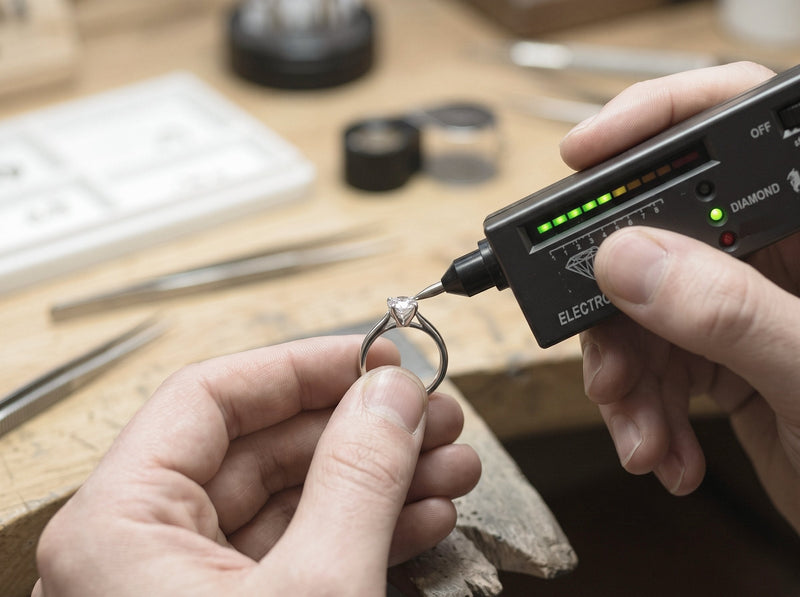
Will a lab grown diamond pass a diamond tester?
Yes, it tests as diamond. Why some HPHT stones read moissanite, why a tester cannot tell lab grown from mined, and how to prove yours.
-
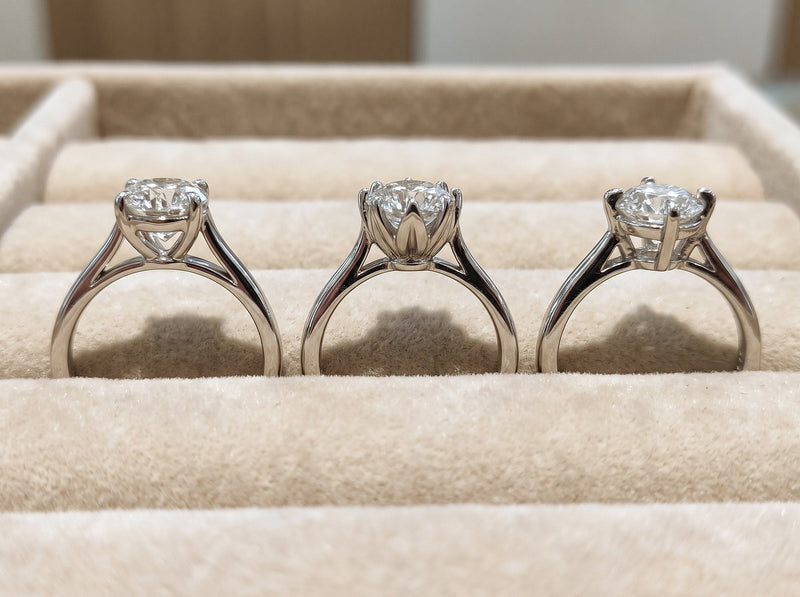
Cathedral, tulip or compass: ring prongs and baskets explained
Four or six prongs, claw, double and V prongs, compass, cathedral, tulip and hidden halo. What each looks like and what it suits.
-

Bezel, half bezel or prongs: which setting is right for you?
Does a bezel make the diamond look smaller or sparkle less? Bezel, half bezel and prongs compared for security, snagging, sparkle and care.


